Rarity & condition
Rare Pokémon Cards: What Makes a Card Valuable?
A first edition stamp. A brilliant holographic illustration. A card with a number larger than the set total. All are reasons to take a closer look, but none is a reliable shortcut to a price. Some of the most collectible Pokémon cards are immediately recognizable; others are valuable precisely because very few people thought to preserve a particular version.
A Pokémon card becomes valuable when buyers want an authentic, identifiable version and the available supply of comparable copies is limited relative to that demand. Condition, distribution, character popularity and the quality of the available market evidence all affect what someone might pay.
By Cash Out on Cards | Educational guide
Editorial disclosure: Cash Out on Cards is an independent card purchasing business and may benefit commercially if you choose to sell to us. We are not a grading or authentication service.
Contents
- Rarity is not the same as value
- Read the card rather than the hype
- First Edition and the Machamp exception
- Promos, trophies and unusual printings
- Condition and professional grading
- Exceptional sales in context
- A checklist for your collection
- Key takeaways
- Frequently asked questions
Rarity is not the same as value
Collectors often use the word rare to describe several different characteristics. Separating them makes it easier to assess a card without being distracted by impressive-sounding listing titles.
| Concept | What it means | What it does not prove |
|---|---|---|
| Printed rarity | The classification assigned to a card within a set | A fixed market price or exact print quantity |
| Distribution scarcity | Relatively limited availability through a release or promotion | That enough buyers want the item |
| Condition rarity | Difficulty finding copies in a particular condition or grade | That the card itself was originally printed in small numbers |
| Desirability | The interest of collectors or players in owning a version | That demand will remain constant |
| Market value | An estimate based on transactions for comparable items | A guaranteed buyer, payout or future price |
A scarce card with a small audience may sell for less than a widely available card of a beloved character. A common card in exceptional condition may attract a premium from collectors pursuing a complete high-grade set. These outcomes are not contradictions. Scarcity matters in relation to demand, and demand depends on which buyers are participating in the market.
Popularity is only one part of the story. Charizard and Pikachu are obvious examples of recognizable characters, but collectors also pursue favorite artists, nostalgic sets, Eevee evolutions, specific Pokémon species and playable cards. A card featuring a less famous character may have a distinctive illustration or a genuinely limited release. Never sort an old collection into valuable and worthless piles based on character names alone.
Read the card rather than the hype
Printed symbols and special numbers
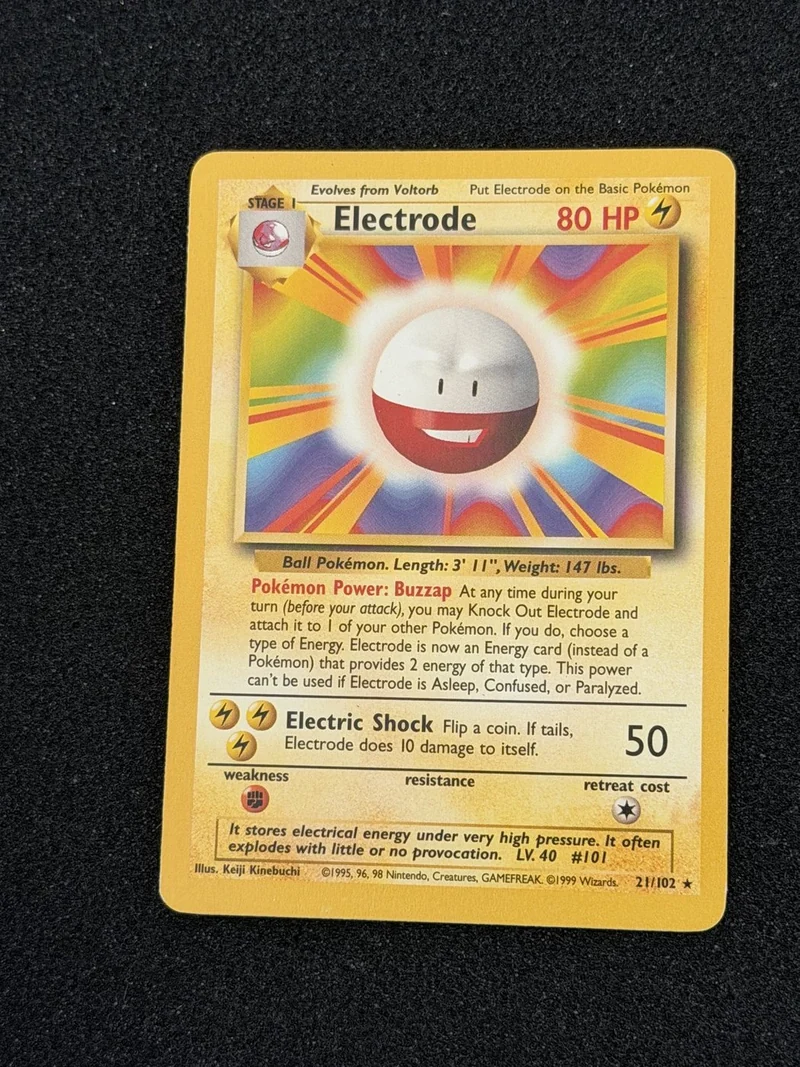
On many early cards, a circle denotes a common, a diamond an uncommon and a star a rare. These classifications describe an expansion's card categories. Modern releases have introduced more elaborate classifications, and their exact symbols can differ from one era to another. The official Pokémon card database help explains the use of rarity information, and Pokémon's Scarlet & Violet design announcement describes changes to the card layout and product presentation.
A number beyond the nominal set size can help identify some special cards. It is a starting point, not a calculation of how many copies were made. Likewise, the words ultra rare in an online listing are not evidence unless they correspond to the correct version.
Foil, artwork and reprints
Holographic and reverse holographic treatments are different finishes. Older holos often have a reflective picture area, while reverse holos commonly reflect elsewhere on the card. Some modern cards have patterned or textured surfaces. An illustration may also cover much of the card face, and a set can contain multiple versions of the same Pokémon.
The existence of a striking finish does not establish that a card is scarce. Pokémon’s Scarlet & Violet design announcement describes how card presentation changed with that series, including replacing expansion symbols with set and language codes. For the exact rarity classification, use the checklist or catalog for the card's own expansion.
Check whether the card is an original release, a later printing or a commemorative reproduction. Similar artwork does not mean two cards belong to the same market. If you find yourself comparing two cards that look almost identical, our card price identification guide provides a practical method for matching them.
First Edition and the Machamp exception
English Base Set, released in 1999, is one of the most recognizable examples of different printings. The early stamped First Edition version and the unstamped Shadowless version of standard cards lack the later printed artwork-frame shadow. The familiar Unlimited layout generally has that shadow. These terms are specific to the relevant early designs; do not apply them mechanically to every set or language.
There is a particularly useful exception to the idea that a First Edition stamp automatically means a card came from the earliest print run: Machamp 8/102.
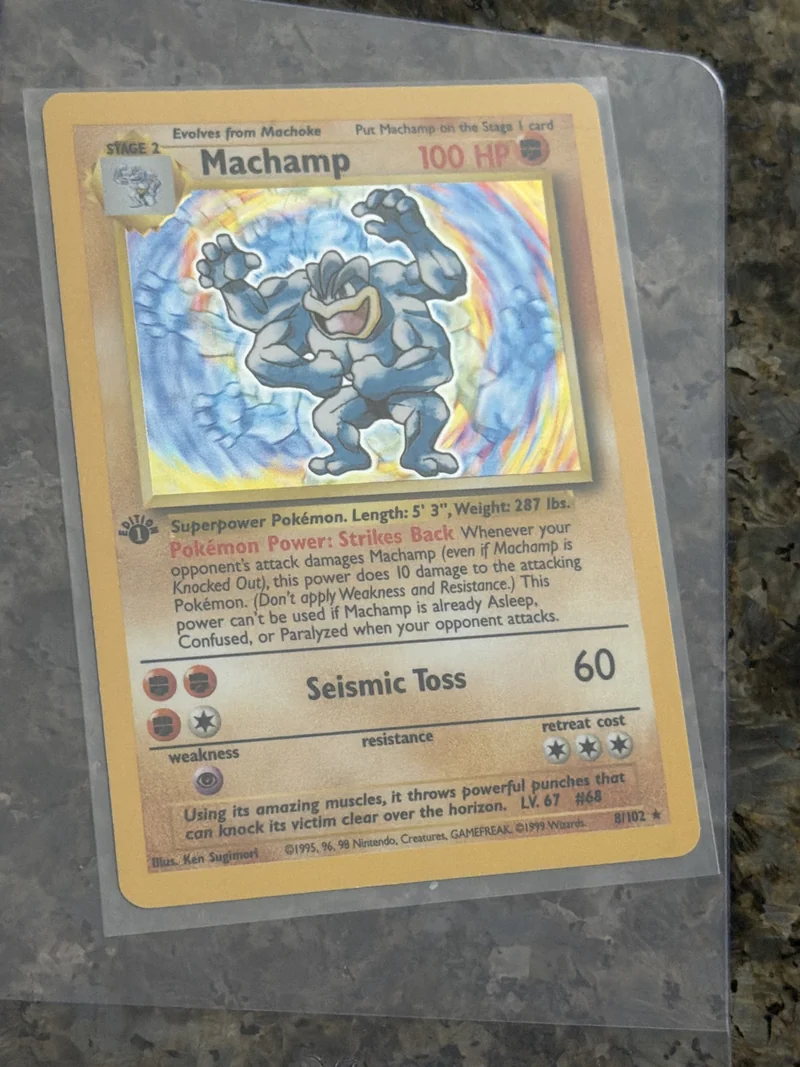
The English Base Set two-player starter product included a holographic Machamp that was not ordinarily available from Base Set boosters. Starter set documentation distinguishes an early Shadowless deck version from a later version. The Machamp release history also records another stamped version associated with a later CD-ROM starter product, featuring a different holofoil treatment. PSA's catalog recognizes a stamped Machamp and separately identifies a stamped Shadowless example.
The visible stamp on the card pictured above is therefore not enough to identify a scarce early variant. The artwork-frame shadow suggests the pictured copy is not the ordinary early Shadowless version. The image is consistent with a later shadowed stamped Machamp, but a front photograph alone cannot settle the exact distribution or foil pattern. It would be misleading to assign it a grade or dollar value from that photograph.
If you own a stamped card, compare its number, artwork, border, typeface, language and finish with a reliable catalog. An ordinary-looking card may be worth researching, while a familiar stamp can appear on a more widely distributed version. The lesson applies beyond Machamp: identify the specific release before judging scarcity.
Promos, trophies and unusual printings
Promotional cards are distributed outside the normal numbered expansion in various ways. Some are included with products, some are issued during events and some are associated with competitions. The term promo does not establish the quantity produced. A broadly distributed product insert has a very different supply profile from a prize presented only to a limited group of participants.
Tournament and trophy cards can be exceptional collectibles because the original opportunity to obtain them may have been unusually restricted. They also often require specialized authentication and provenance research. A card that merely looks like a trophy card or features a medal motif is not necessarily an original award.
Printing errors are another area where careful research matters. An unusual factory-produced variation may be collected if it is genuine and recognized. Examples can include documented differences in printed artwork, foil treatment or alignment. A crease, scraped ink, fading, stain or damage caused by storage is different. Damage is not an error simply because it looks unusual.
If you suspect a genuine manufacturing variation, keep the card unaltered. Photograph it front and back, compare known examples and seek a specialist opinion if the possible value warrants it. Do not attempt to create or enhance an error. A marketplace description using words such as misprint or one of a kind is not proof of authenticity or a premium.
Counterfeits can imitate popular old cards, stamps, labels and modern foil finishes. Compare the exact edition to trusted references and watch for inconsistent typography, unusual colors, incorrect artwork, misplaced elements or implausible prices. These clues can indicate the need for further investigation, but a single visual test is not definitive. Do not rip, scratch or otherwise damage a card to test it. If a purchase or sale depends on authenticity, qualified independent assessment may be appropriate.
Condition and professional grading
The condition of a card can be just as important as the printed version. Two authentic copies from the same set may have very different appeal to a collector.
| Area | What to examine |
|---|---|
| Centering | Whether the printed design is positioned evenly relative to the borders on both sides |
| Corners | Fraying, rounding, dents, bends or other damage |
| Edges | Whitening, chipping, peeling or wear |
| Surface | Scratches, indentations, fingerprints, stains, print defects and foil wear |
| Overall integrity | Creases, moisture damage, alterations or other structural problems |
Look at a card under diffuse light and change the angle gently. A flat photograph can conceal a shallow dent or surface scratch. If an older sleeve is stuck, do not force the card out. A clean front alone cannot establish the condition of the back.
Professional grading companies publish criteria for assessing cards. PSA's grading standards use numerical grades and consider multiple aspects of condition and appearance. CGC's grading scale has its own terminology and distinctions, and Beckett's grading information describes assessment of centering, corners, edges and surface. The same number from different companies should not automatically be assigned the same market value.
A grading label provides an independent opinion under that company's standards. It does not make an ordinary card scarce, guarantee a resale price or remove every authenticity risk. Verify a certification through the grader's official service and compare the actual holder and card when possible. A valid number can be copied onto an imitation label.
Is grading economically worthwhile?
Imagine a raw card with a realistic sale estimate of $60. You pay $30 in grading and allocated shipping expenses. If the graded card sells for $100, the difference before selling costs is only $10 compared with selling raw. If it sells for $70, the result is worse than the raw sale. These are hypothetical figures; service costs and actual grades vary.
Look at multiple plausible outcomes, including lower grades. Consider whether the expense, waiting time and risk are appropriate. For a low-value card, the grading bill may exceed any likely increase in proceeds. For a distinctive high-value card, independent authentication and grading may be especially useful. Neither conclusion applies to every card.
Exceptional sales in context
Some Pokémon cards have achieved extraordinary auction prices. These are useful for understanding the effects of edition, scarcity and condition, not for assigning prices to cards in an everyday binder.
| Item | Grade | Documented result |
|---|---|---|
| 1999 English Base Set First Edition Charizard, 4/102, holo | PSA Gem Mint 10 | $336,000, Heritage Auctions, March 4, 2022 archived lot |
| 1999 English Base Set unstamped Shadowless Charizard, 4/102, holo | PSA Gem Mint 10 | $72,000, Heritage Auctions, December 2, 2022 archived lot |
| 1998 Japanese Pikachu Illustrator contest promotional card, holo | PSA Gem Mint 10 | $16,492,000, Goldin, February 16, 2026 Guinness record / auction description |
The Heritage figures are published sold totals; the listed buyer's premium for each auction was 20% of the winning bid. The Illustrator result is a reported total for an exceptional offering that also included a custom necklace and personal delivery, as described by Goldin. These results are historical, not current market quotes. They cannot establish the value of a different grade, an ordinary Pikachu or an ungraded Charizard. Different auction dates also mean the Charizard rows are not a controlled experiment measuring the edition premium.
Most people will encounter ordinary expansion cards, familiar holos, promotional releases and modern special artwork long before they encounter a trophy card. Those ordinary collections can still be interesting to buyers. The best way to evaluate them is through relevant comparable transactions, rather than a headline about an exceptional sale.
A checklist for your collection
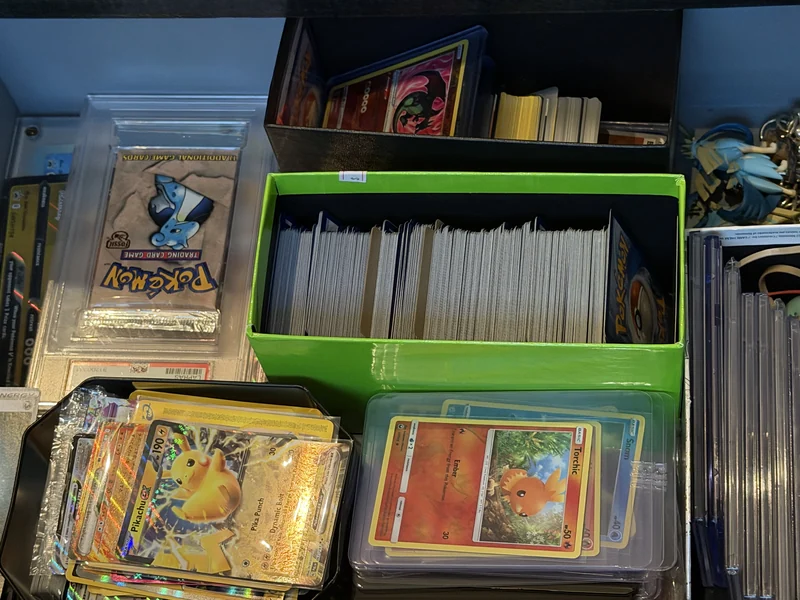
You do not need to understand every rarity designation to decide what deserves a second look. Here are useful visual clues:
- Early edition marks, older layouts and expansion symbols.
- Distinctive artwork, original-looking promos and unusual card numbers.
- Foil or texture differences between otherwise similar cards.
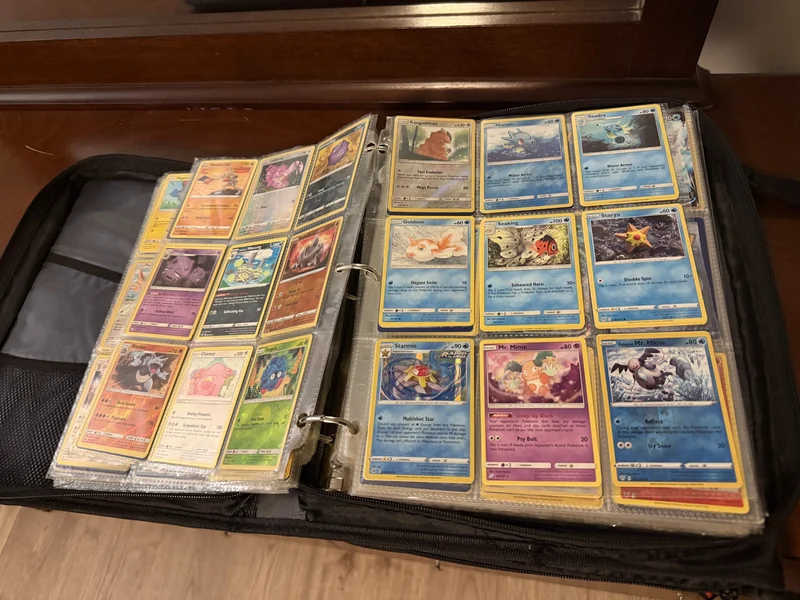
- Well-preserved cards, even if their printed rarity is common.
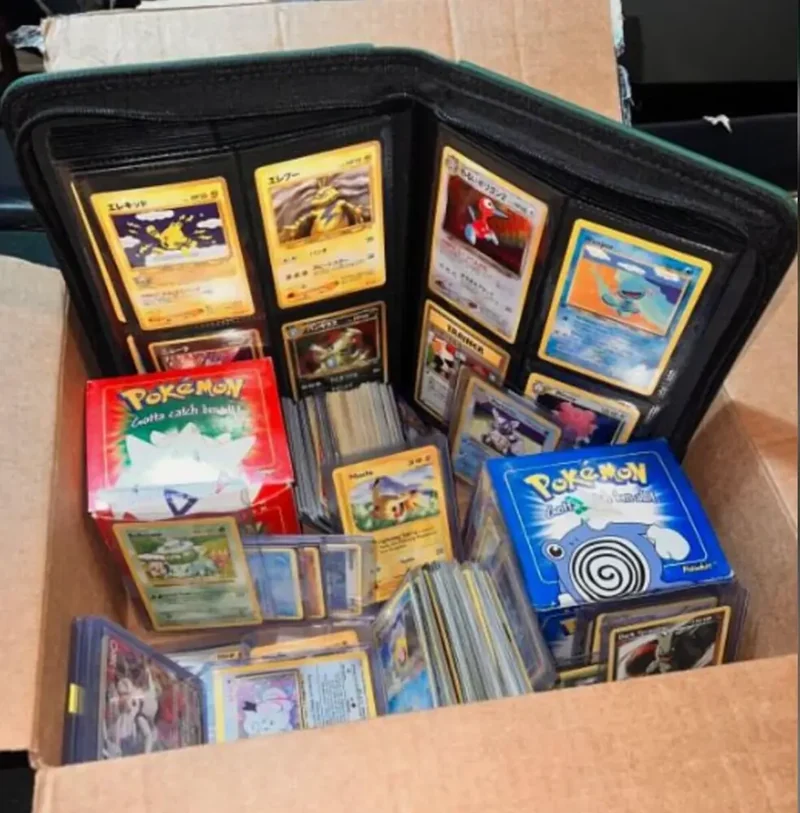
- Sealed products and professionally graded cards.
- Unfamiliar cards from older sets, non-English releases or limited events.
- Documented differences that might indicate a genuine printing variation.
Keep these clues as a shortlist for research, not a promise of value. If your cards have been in storage for years, our guide to forgotten vintage collections explains how to examine them gently. Our Pokémon market guide explains why popularity and supply change.
Not sure whether you have something rare? Show us a few collection photographs for a free, no-obligation purchase review. There is no need to identify each card before contacting us.
Key takeaways
- Printed rarity, actual supply and market demand are different concepts.
- First Edition stamps, shiny surfaces and unusual numbers require version-specific research.
- Condition can make copies of the same card very different in value.
- Extraordinary auction sales are documented exceptions, not ordinary collection estimates.
- Never alter a card in an attempt to improve its appearance or grade.
Frequently asked questions
Does a First Edition stamp mean my Pokémon card is rare?
Not necessarily. It identifies an edition mark, but the actual distribution and availability depend on the card. English Base Set Machamp is a particularly useful exception because stamped copies appeared in different starter products.
Are cards with a star always worth money?
A star can identify a rare category on many older releases. The card may still be readily available or have modest demand. Use the set-specific rarity key and completed sales of the exact version.
Can modern cards be worth more than vintage ones?
Yes. Strong demand, distinctive artwork and limited availability can make a modern card more valuable than a particular older card. Age is not a universal measure of value.
Is a grading population the total number of cards in existence?
No. A grading population reflects a company's recorded grading activity. Ungraded copies, other companies' records and classification limitations mean it is not a worldwide census.
What if I think I have a valuable misprint?
Keep it unaltered, photograph both sides and compare documented examples. Seek qualified authentication if necessary. Ordinary damage is not proof of a factory error.
How can I tell if a rare-looking Pokémon card is fake?
Compare the exact release with reliable reference images, examine print details and verify any grading label with the issuer. Suspicious signs justify further investigation, but photos alone may not settle authenticity.
Do I have to grade every rare card before selling it?
No. Compare the cost and risk of grading with realistic raw and graded sale estimates. It may be appropriate for selected cards, but it is not a prerequisite for seeking an offer.
Have cards you want to learn more about or sell?
Start with our guide to checking prices, compare your selling options, or send us your collection for a free, no-obligation purchase review. No guaranteed offer or professional grade is implied.
Sources and further reading
- Pokémon Support — card database; Pokémon — Scarlet & Violet design changes
- Bulbapedia — Machamp and two-player starter set (specialist catalog references)
- PSA — Machamp CardFacts and Shadowless Machamp certification example
- PSA grading standards, CGC grading scale, Beckett grading
- Heritage Auctions — March 2022 First Edition Charizard and December 2022 Shadowless Charizard
- Guinness World Records — Pikachu Illustrator auction; Goldin — auction description